

Yes, calling a person "oriental" is offensive and considered a slur. The term is rooted in a colonial past where it was used by Westerners to exoticize and stereotype a vast and diverse group of people from Asia. While it might seem like a simple geographical descriptor for "eastern," it carries a heavy legacy of dehumanization, treating people like objects and erasing their specific cultural identities. Modern, respectful language uses specific nationalities (like Korean or Thai) or broader, more accurate terms like "Asian."
Why "Oriental" Is Considered a Slur

To understand why "oriental" is a problem, you have to look beyond its dictionary definition. The word's modern meaning was shaped by Western colonialism, which created an "us vs. them" dynamic. It painted countless distinct cultures with a single, outdated, and subservient brush. Historically, the term became a common racial slur in Western countries, especially in the United States during the 19th and early 20th centuries amid rising anti-Asian sentiment. Digging into the historical context helps clarify its origins as a harmful label.
The Problem of Dehumanization
When applied to a person, "oriental" stops being a simple descriptor and becomes a label that erases their humanity. It's a term often used for inanimate objects—like a rug, a vase, or a style of furniture. Using that same adjective for a person reduces them to an exotic object, something foreign and less than human.
This is the core issue: the word suggests a person is just a representative of a mysterious, monolithic "Orient" instead of an individual with a specific identity, such as being Korean, Vietnamese, or Pakistani.
The real harm of the word 'oriental' is that it denies people their specific identity. It’s a blanket term rooted in a perspective that sees a huge part of the world and its people as one and the same.
This lazy shortcut glosses over the incredible diversity of cultures, languages, and histories spanning the Asian continent, propping up old and harmful stereotypes.
Key Reasons the Term Is Offensive
| Reason | Explanation |
|---|---|
| Colonial Baggage | The word comes from a time of European imperialism and was used to define Asian people as 'other' and subordinate. |
| Dehumanizing | It treats people like objects, lumping them in with inanimate items like rugs, food, or furniture. |
| Overly Broad & Vague | It erases the vast diversity of Asia, treating billions of people from dozens of countries as a single, uniform group. |
| Outdated & Inaccurate | It's a relic of the past. Modern language uses specific nationalities or regional terms (e.g., East Asian, South Asian). |
Ultimately, 'oriental' is a term that belongs in history books. For respectful, clear communication today, we need to leave it there.
Unpacking the Word’s Colonial Baggage
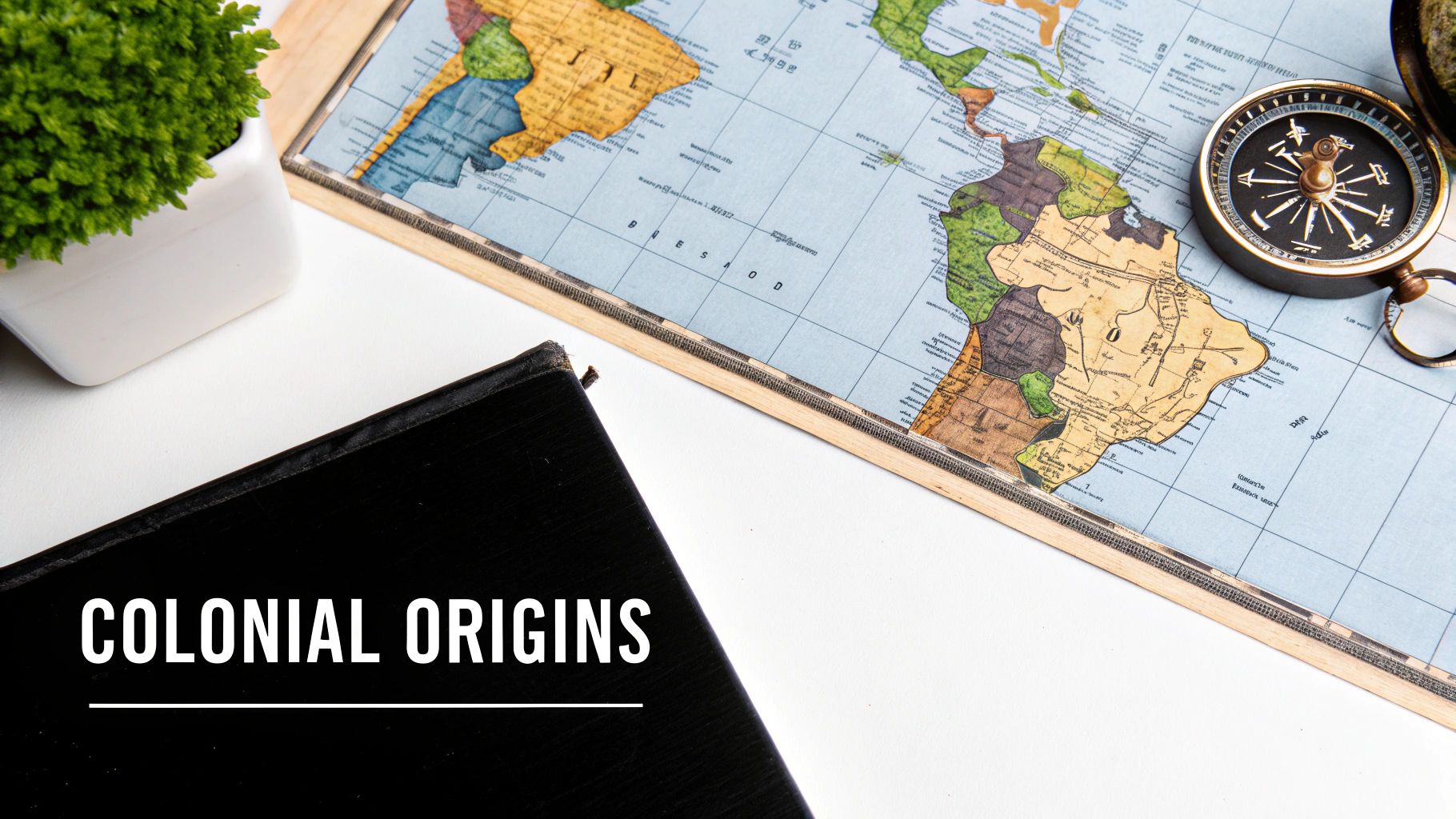
To really understand why 'oriental' lands so poorly today, we need to look at its history. The word started innocently enough, coming from the Latin orientalis, which simply means 'eastern'. For a long time, it was just a geographical term used by Europeans to talk about the lands where the sun rises.
But during the peak of Western colonialism, this neutral word took a sinister turn. It wasn't just about geography anymore; it became a loaded term used to create an 'us versus them' dynamic. European powers used it to draw a thick line between their 'occidental' world and the so-called 'oriental' East.
A Weapon of Othering and Empire
Suddenly, 'oriental' was drenched in stereotypes. It conjured images of a land that was exotic, mysterious, and—crucially—inferior and uncivilized. This narrative was incredibly convenient for colonial powers, giving them a ready-made justification for everything from economic exploitation to military invasion.
The word 'oriental' is tied to a painful history of racism and imperialism. It carries the weight of empires that saw Asian people not as equals, but as a single, exotic mass to be ruled, studied, and controlled.
This framing of Asian cultures as "alien" was cemented in Western books, government policies, and academic theories throughout the 18th and 19th centuries. This wasn't just talk; it shaped real-world discriminatory laws and fuelled prejudices that we still see the echoes of today. The word isn’t just old-fashioned; it’s a living relic of a system built on a racial pecking order. This is a familiar pattern of colonialism, and similar legacies can be found across many of East Africa's nations, where imposed languages and labels also left a lasting mark.
How Outdated Words Fuel Modern Stereotypes
Words have a way of sticking around, but some, like ‘oriental,’ carry a heavy, harmful legacy. It’s not just an old-fashioned term; it’s a lazy label that flattens the distinct cultures of billions of people across dozens of countries, from Korea to Pakistan. This feeds an ugly idea: the "perpetual foreigner" stereotype. It’s the hurtful notion that no matter where someone of Asian descent was born, they’re still seen as an outsider who doesn't really belong.
The Real-World Ripple Effect
The line between outdated words and real-world prejudice is something people live with every day. Lumping diverse groups under one banner reinforces the stereotypes that lead to discrimination and hostility. This kind of language can normalize a casual racism that makes it easier for more dangerous attitudes to grow. A casually tossed-out slur can be the first step down a path that ends in harassment and violence.
Choosing our words with care is one of the most practical things we can do to dismantle prejudice. When we stop using terms like 'oriental,' we’re not just being polite; we are actively turning our back on a colonial way of thinking and making a commitment to see people for who they truly are.
The damage these slurs cause isn't abstract—it's measurable. A recent national survey from The Asian American Foundation found that nearly one-third (32%) of Asian Americans said they’d been called a racial or ethnic slur in the past year. For some, it's even worse: around 40% of Southeast Asian Americans reported the same abuse. You can dig into the data in the full 2024 STAATUS Index report. These statistics are a stark reminder of why ‘oriental’ is now considered a slur; it directly fuels painful experiences of racism and exclusion.
Knowing When the Word Is Acceptable
So, does this mean ‘oriental’ is always off-limits? Not quite, but the distinction is crucial. The simplest rule of thumb is this: it’s for things, not people.
While the term is deeply offensive when used to describe a person, it still hangs on in a few specific contexts. You'll still see it in long-established proper nouns, like for ‘Oriental rugs’ or the famous ‘Orient Express’ train. These are historical names tied to specific objects. Think of it this way: you might describe a chair as being in the ‘art deco’ style, but you would never call a person ‘a deco.’ The word describes the object, not a human being.
The Things vs. People Test
This simple framework is really all you need. Are you talking about an object with a long-standing, historical name? If yes, it might be okay. But are you referring to a person, a community, or a culture? Then you must find a better, more specific word.
This decision tree visualizes the thought process perfectly.
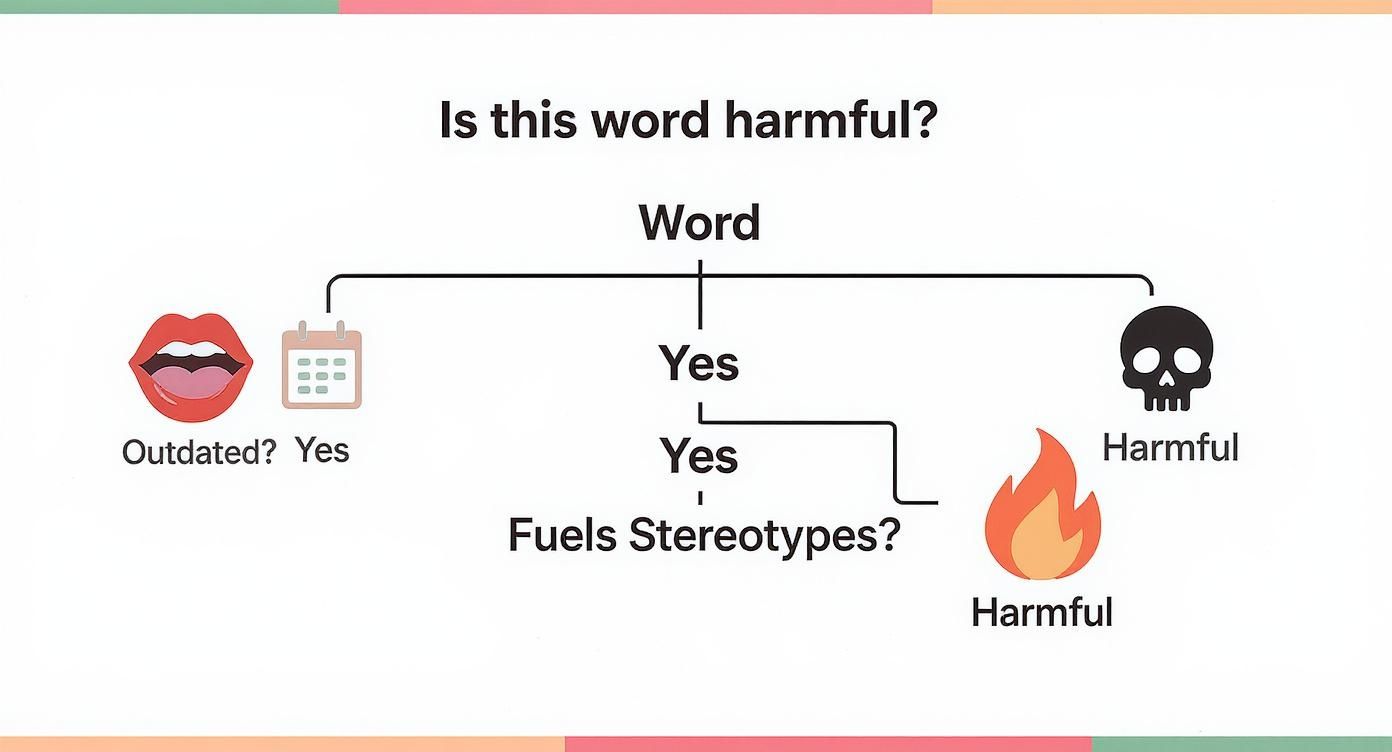
As the chart shows, words that are outdated and fuel stereotypes are harmful. That’s exactly what happens when ‘oriental’ is used to describe people. To make it even clearer, here’s a straightforward comparison.
Acceptable vs. Unacceptable Uses of 'Oriental'
| Context | Acceptable Use (Objects/Proper Nouns) | Unacceptable Use (People) |
|---|---|---|
| Home Décor | "She bought a beautiful antique Oriental rug." | "She hired an Oriental decorator for her home." |
| Travel | "They booked tickets on the historic Orient Express." | "The tour guide was a friendly Oriental man." |
| Cuisine | Referring to a specific brand like "Oriental Trading" | "I'm going to that Oriental restaurant downtown." |
The pattern is clear: historical brand and product names get a pass, but applying the label to people, their professions, or even their businesses is where it becomes a problem.
Choosing Respectful and Accurate Alternatives
What should you say instead of an outdated word? The best approach is simple: be as specific and accurate as you can. Using respectful language is a cornerstone of basic human decency, a principle we stand by in our platform's terms of service. If you know where someone is from, use that. Saying someone is Korean, Filipino, or Indian is far more meaningful than using a vague and loaded term. This small shift acknowledges their unique identity.
From General to Specific
Sometimes you need a broader term when talking about a group. In that case, ‘Asian’ is the modern, widely accepted standard. It works just like ‘European’ or ‘African’—a neutral term that refers to a continent. If you need more detail, regional labels are a great way to acknowledge the massive diversity across Asia.
Using specific terms like 'East Asian' or 'South Asian' is a powerful way to push back against the harmful stereotype that all Asian people are the same. It shows you recognise the continent’s vast cultural diversity.
Here are the most common regional alternatives:
- East Asian: This generally refers to people from countries like China, Japan, Korea, and Mongolia.
- South Asian: This term is typically used for people from places like India, Pakistan, Bangladesh, Nepal, and Sri Lanka.
- Southeast Asian: This covers people from nations such as Vietnam, Thailand, the Philippines, Indonesia, and Malaysia.
- Central Asian: This includes people from countries like Kazakhstan, Uzbekistan, and Afghanistan.
By choosing these alternatives, you’re not just avoiding offense. You're communicating with more clarity, accuracy, and thoughtfulness.
Why This Conversation Matters Globally and in Uganda
You might wonder why a word born out of Western colonialism is relevant in Uganda. The legacy of that era spread wherever colonial rule took hold. In Uganda's case, British influence embedded certain racial hierarchies and the language used to maintain them. These outdated ideas and terms linger even today.
Now, this conversation is more important than ever. Uganda is a diverse country with a growing and vibrant Asian community. Using respectful language isn't just a global issue—it's about building a stronger, more inclusive community right here.
Adopting inclusive language is about much more than just avoiding one offensive word. It is an active rejection of a colonial mindset and a step towards building stronger, more respectful communities for everyone.
A Universal Act of Solidarity
When we stand up for respectful language, we're doing more than being polite. It’s an act of solidarity that connects us with people across the globe who are also working to dismantle old prejudices. It's about seeing the person, acknowledging their history, and making sure everyone feels seen and valued.
Whether you're in Kampala or Chicago, the principle is the same. Choosing our words thoughtfully helps create spaces where everyone feels welcome. This simple shift enriches our communities and makes exploring the best places to visit in Uganda a better experience for locals and visitors alike.
Common Questions and Answers
Even with a grasp of the history, it's easy to get tripped up in real-life situations. Here are some of the most common questions about using the word ‘oriental.’
What if I hear an older person use the word "oriental"?
This happens a lot. Many older people grew up when ‘oriental’ was a common term, so they might not know it’s now considered offensive. The best approach is usually a gentle one, aiming to educate rather than confront. You could say something like, “Just so you know, I’ve learned that ‘Asian’ is the better term to use these days. ‘Oriental’ has some painful history attached to it.” The idea is to share a new perspective kindly.
Why is "Asian" okay but "oriental" is not?
This question gets to the heart of the issue. Think of ‘Asian’ as a neutral, geographical term, like ‘European’ or ‘African.’ It's broad, but it doesn't come with the same historical baggage. ‘Oriental,’ on the other hand, was a label invented by Westerners to frame Asian people as exotic, mysterious, and fundamentally 'other'—and usually, inferior. Its entire history is tangled up in objectification and harmful stereotypes.
Using the term 'Asian' acknowledges geography without the weight of colonial-era prejudice. 'Oriental' does the opposite—it centres a historical power imbalance and reduces people to a stereotype.
What about the phrase "the Orient"?
Just like its adjective form, ‘the Orient’ is an outdated phrase steeped in a colonial mindset. It brings to mind romanticized, stereotypical images of a mysterious and uniform East, which ignores the reality of an incredibly diverse continent. You'll still see it in old books or film titles, but it’s not the right way to refer to Asia or its countries today. It’s always better to be specific and name the actual country or region you’re talking about.
For more answers to common travel and cultural questions, you can find a wealth of information in our FAQs for visiting East Africa.
From planning your adventure to understanding local culture, HelloEastAfrica is your trusted guide to the region. Explore our travel tools and start building your perfect trip today.


Comment (0)