

The term "oriental" literally means "eastern" and was historically used by Westerners to describe anything from Asia. Today, the oriental meaning is complex and often considered offensive when used to describe people. This is because the term is rooted in a colonial history that grouped diverse cultures into a single, stereotyped category. While it may still be used to describe objects, like an "Oriental rug," applying it to people is outdated and disrespectful. It is always better to use specific nationalities, such as Chinese or Korean, or regional terms like East Asian.
What Exactly Does Oriental Mean Today?
The word "oriental" comes from the Latin word oriens, which means "rising"—a reference to the rising sun in the east. For centuries, Europeans used it as a geographical term for lands east of them, spanning from the Middle East to East Asia. However, as European colonialism expanded, the word's meaning shifted. It became a loaded label that lumped hundreds of distinct cultures together, often in a patronizing or exoticizing way. This historical baggage is why the term is problematic today.
The Problem with Generalisations
Using "oriental" to describe a person is offensive because it’s an outdated label imposed by outsiders, not a term people from Asia chose for themselves. It carries the weight of a history where one group defined another, often inaccurately.
Imagine lumping people from Canada, Spain, and Australia together as "Westerners." While technically correct, the label erases their unique cultures, languages, and histories. The same issue applies to using "oriental" for people from Asia.
The core issue is that the term incorrectly groups hundreds of diverse cultures into one category, perpetuating stereotypes rather than promoting understanding. It is a relic of a Eurocentric worldview that fails to acknowledge the rich complexity of Asia.
Being specific is always the best approach. Instead of a vague, outdated label, it is more accurate and respectful to refer to someone by their nationality (like Japanese, Vietnamese, or Indian) or their specific regional identity (such as East Asian or South Asian).
Quick Guide to Using the Term 'Oriental'
This table summarises the key points to remember when you encounter the word.
| Context | Traditional Meaning | Modern Perception | Recommended Alternatives |
|---|---|---|---|
| People | A person from "the Orient" (Asia). | Offensive, outdated, and associated with colonial-era stereotypes. | Use specific nationalities (e.g., Chinese, Thai, Korean) or regional terms (e.g., East Asian, South Asian). |
| Objects | Something originating from or in the style of Asia. | Generally acceptable for specific historical items like rugs, vases, or furniture. | Being specific is still better (e.g., "Persian rug," "Chinese porcelain"). |
| Geography | The lands east of Europe. | Archaic and geographically imprecise. | Use modern geographical names like Asia, East Asia, Southeast Asia, or the Middle East. |
Ultimately, the goal is clear communication and respect. Knowing the history behind a word helps us choose our language more thoughtfully.
The Historical Journey of the Word Oriental
To understand what ‘oriental’ means today, we have to look back at its history. The word’s origin is geographical, starting with the Latin word oriens, meaning "rising." This was a literal reference to the direction of the rising sun—the east.
For centuries, Europeans used "oriental" as a neutral descriptor for the lands east of them. It was a simple directional tag, much like we’d use "northern" or "southern." It defined a place based on its position relative to Europe, which was seen as the point of reference.
However, during the age of European colonialism, the word's meaning changed significantly. As Western powers expanded their influence across Asia and the Middle East, "oriental" took on new, heavier connotations.
From Geography to Stereotype
The word evolved from a geographical marker to a sweeping cultural label. It was used to describe the people, art, and traditions of an enormous and diverse part of the world, lumping together countless distinct cultures—from Turkey to Japan—under a single umbrella.
This generalization created an "us vs. them" dynamic, portraying the "Orient" as a mysterious, exotic, and often primitive land compared to the "civilised" West. This shift in language helped reinforce a power imbalance. You can find more discussions on authentic cultural exploration over on our travel blog.
The term became a tool of empire, creating a convenient but deeply inaccurate narrative that justified colonial ambitions. It wasn't just a word; it was a reflection of a Eurocentric worldview that positioned the West as the global standard.
This is the historical baggage the word carries today. It’s a relic of an era when rich, complex societies were flattened into a single, often demeaning, caricature. Understanding this history is key to knowing why using the word now is so complicated.
Why the Term ‘Oriental’ Fell Out of Favour
The word ‘oriental’ became problematic because it bundles the immense diversity of Asia into a single, exotic stereotype. This generalization is dehumanizing, as it flattens countless vibrant cultures into one mysterious "other." It’s this historical baggage that makes the term so loaded today.
A significant issue is the power dynamic behind the word. ‘Oriental’ was a label given to Asian people by Western explorers and colonizers, not a name they chose for themselves. This origin is rooted in colonialism, where one culture had the power to define and misrepresent another. For many people of Asian descent, the word is a reminder of this history.
Wiping Out Diversity with a Single Word
Asia is a continent with over 4.7 billion people, thousands of languages, and a vast array of cultures. Attempting to describe this diversity with one word is impossible and dismissive.
This sweeping generalisation led to harmful stereotypes. In Western art and literature, the "Orient" was often portrayed as:
- Exotic and mysterious: A fantastical land, not a real place with ordinary people.
- Static and unchanging: Presenting Asian societies as stuck in the past, unlike the "progressive" West.
- Submissive and passive: A damaging stereotype that has particularly affected perceptions of Asian women.
These stereotypes shaped political policies and social attitudes for generations, creating a caricature that was easier to dominate than to understand.
The Lasting Legacy of ‘Othering’
At its core, the term creates an "us vs. them" divide. It establishes Europe and the West as the default and everything to the east as the "oriental" exception. This framing reinforces an outdated and disrespectful Eurocentric worldview.
The real issue with the word is that it frames Asia as a passive entity, one that is only understood in relation to the West. It doesn't allow Asian peoples and cultures the space to define themselves on their own terms.
Moving away from using ‘oriental’ for people is part of a broader shift toward more precise, respectful, and inclusive language. It’s about being mindful of history and choosing words that celebrate cultural diversity rather than erasing it.
Navigating Modern Usage with Respect
So, when can you use the word ‘oriental’ without causing offence? The simple rule is that it’s generally acceptable for things, not people.
Describing an ‘Oriental rug’ or ‘Oriental porcelain’ is often fine because these terms refer to specific, historical styles of craftsmanship. However, applying that same label to a person is a problem. It’s an outdated, colonial-era term that strips away their identity and places them in a stereotyped box. Understanding the modern oriental meaning requires grasping this crucial distinction.
This infographic breaks it down further.
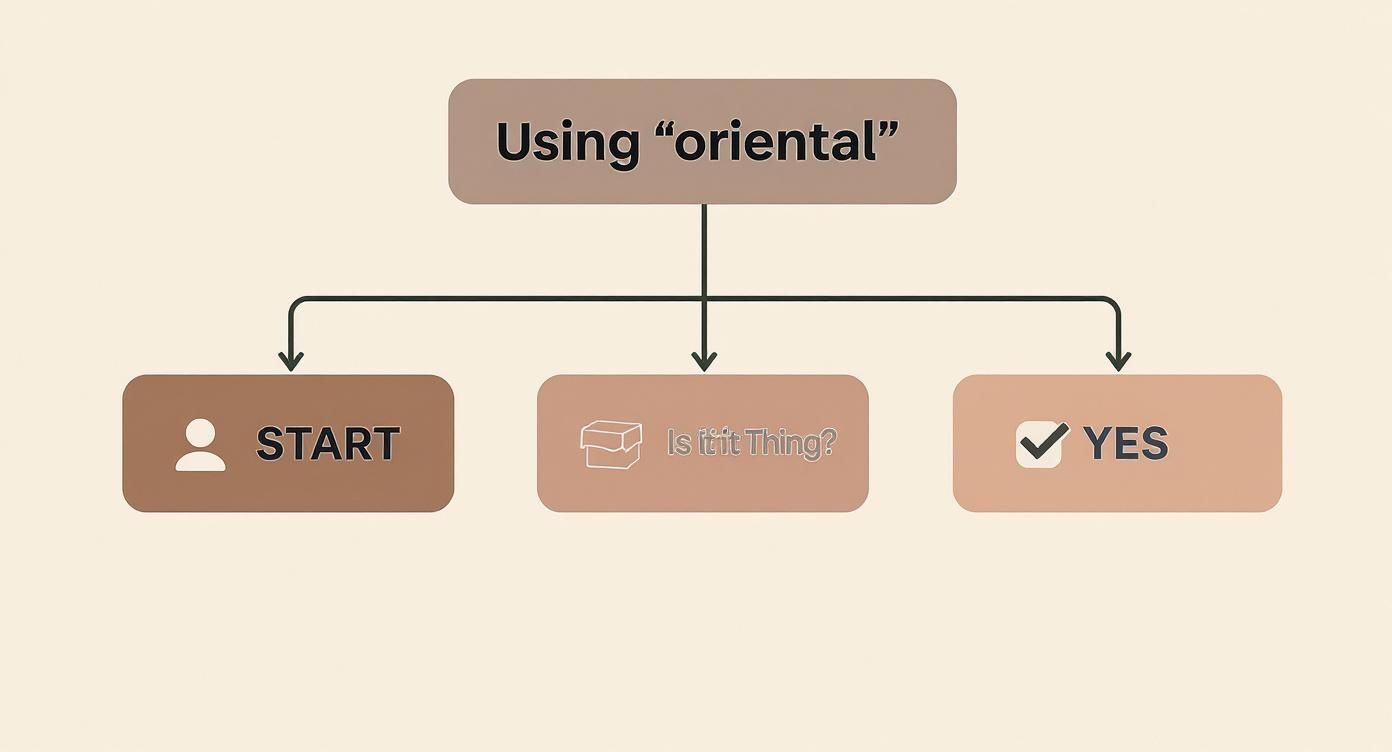
The path is clear: if you’re talking about a person, the answer is no. If it’s an object, especially in a historical context, it’s usually acceptable.
Choosing Better Alternatives
Instead of using a vague and loaded term, be more precise. Using specific language shows respect for the people and cultures you’re describing.
Here are some much better options:
- Go for Nationality: This is always the best choice. Saying someone is Korean, Thai, Filipino, or Chinese acknowledges their unique heritage.
- Use a Regional Term: If you don't know their nationality, broader labels like ‘East Asian,’ ‘South Asian,’ or ‘Southeast Asian’ are more accurate.
- Focus on the Culture: When discussing art or traditions, name the culture directly. Talk about ‘Lunar New Year traditions’ or ‘Japanese calligraphy,’ not a generic ‘oriental’ custom.
The goal is to move beyond monolithic labels that flatten diverse cultures into one. By choosing specificity, we acknowledge the rich and complex identities of individuals and communities across Asia.
Navigating these nuances can seem tricky, but these guidelines make it straightforward. If you'd like to dive deeper, join the conversation on our community forums. A little thoughtfulness goes a long way in making sure our words connect rather than divide.
Putting the Term's Geographical Limits in Perspective
To understand how "oriental" is a constructed concept, it helps to look at a place where the word has no meaning, such as Uganda. The term has no historical, cultural, or demographic relevance there. This highlights that the word is a European creation tied to a specific worldview, not a universal label for people.
When we consider a nation far removed from the colonial mindset that invented the term, its limitations become clear. The label doesn't apply because it was never meant for that part of the world, revealing its artificial and specific origins.
A Look at Uganda
Uganda’s cultural fabric is incredibly rich, with over 50 different ethnic groups, each with its own language and traditions. The population is overwhelmingly African. For example, the largest ethnic group, the Baganda, makes up just 16.9% of the total population, illustrating its diversity.
The term "oriental" is completely absent from official demographic data in Uganda. This absence confirms that the term is an external label, not a self-identifier for diverse global communities.
The term ‘oriental’ is a geographical and cultural concept born from a European perspective. Its complete irrelevance in a country like Uganda proves that it is not a universally applicable term but a specific, and now outdated, historical label.
This stark contrast deconstructs the old notion that "oriental" is a generic catch-all for anyone non-Western. It exposes the word's specific and problematic historical and geographical boundaries. A great way to understand why specific language is so important is to explore the vibrant diversity across East Africa's nations.
Why Generic Labels Fail a Global Comparison
Using a sweeping label like ‘oriental’ for diverse groups of people erases the vast differences that define human experience across the globe. The modern oriental meaning falls apart when examined with demographic data.
A powerful way to see this is by comparing population trends.
Consider Uganda, a country where the term 'oriental' has no cultural relevance. Its population is projected to double in just 26 years by 2025. This rapid growth shapes its entire society, from economic priorities to social structures. You can explore these trends further in this detailed geographical analysis.
This reality is worlds away from the experiences of many nations once mislabelled as 'oriental'.
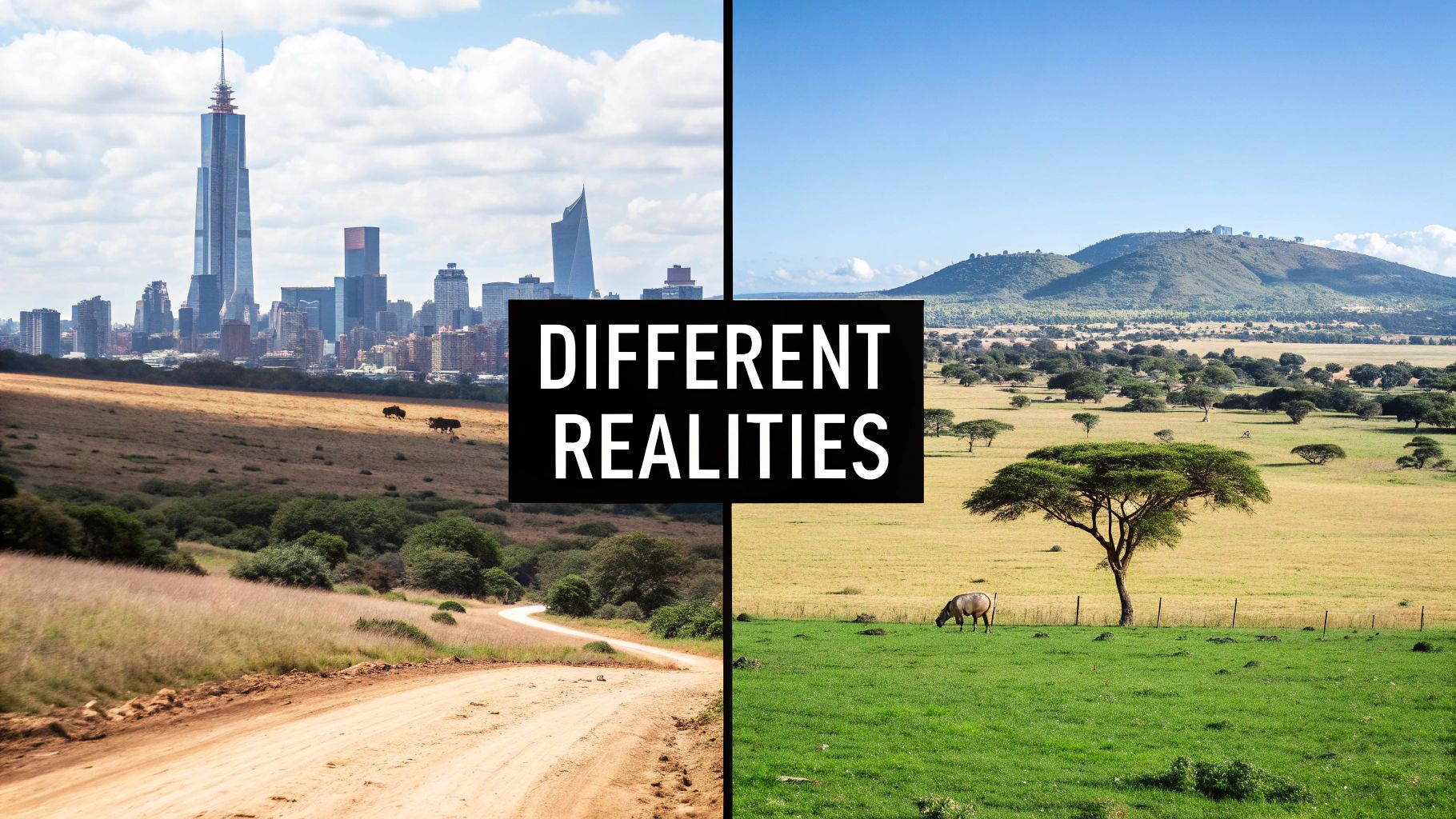
Opposing Realities Expose Flawed Logic
For a sharp contrast, look at Japan. Its demographic story is the opposite. Japan’s population has been shrinking since 2010, with a negative growth rate. These two countries are on completely different trajectories.
This comparison alone shows how absurd it is to use one generic term for such different peoples. The challenges and opportunities facing a rapidly growing nation like Uganda are fundamentally different from those in a country with an ageing, shrinking population like Japan. Their approaches to resource management, healthcare, and urban planning are driven by opposing forces.
These opposing realities prove that monolithic concepts like 'the Orient' are not just inaccurate; they are useless for genuinely understanding global cultures. Specific, accurate language is essential for meaningful cross-cultural dialogue.
Ultimately, these demographic snapshots drive home a crucial point. To be respectful and accurate, we must dismantle lazy, one-size-fits-all labels and appreciate the rich complexity of individual nations and cultures for what they are.
Frequently Asked Questions
Here are clear, direct answers to common questions about using the word ‘oriental’ today.
Can I Still Describe an Object as Oriental?
Yes, for objects, but with caution. Terms like ‘Oriental rug’ or ‘Oriental porcelain’ are still used, especially for historical items or specific design styles. In these contexts, the term is generally understood. However, being more specific, such as saying a ‘Persian’ or ‘Turkish’ rug, is always better as it is more accurate and appreciative.
What’s the Real Difference Between Oriental and Asian?
‘Oriental’ is an outdated, Eurocentric term meaning ‘from the East’ and is associated with a colonial past. It is vague and often offensive when used for people. ‘Asian’ is the correct and respectful geographical term for anyone from the continent of Asia. When referring to people, always use Asian. The words are not interchangeable.
Why Does Being Specific Matter So Much?
Using vague labels like ‘oriental’ erases the incredible diversity across Asia, grouping hundreds of distinct cultures into one inaccurate, stereotyped category. Being specific by using terms like Korean, Vietnamese, or South Asian respects the unique identity and culture of individuals. For more answers to your travel and culture questions, check out our comprehensive East Africa FAQs.
At HelloEastAfrica, we believe thoughtful travel begins with understanding. We provide the tools and insights to help you explore East Africa with confidence and respect. Start planning your unforgettable journey today. https://helloeastafrica.com


Comment (0)